Customer journey
Describe the journey. OrgGen structures the blueprint.
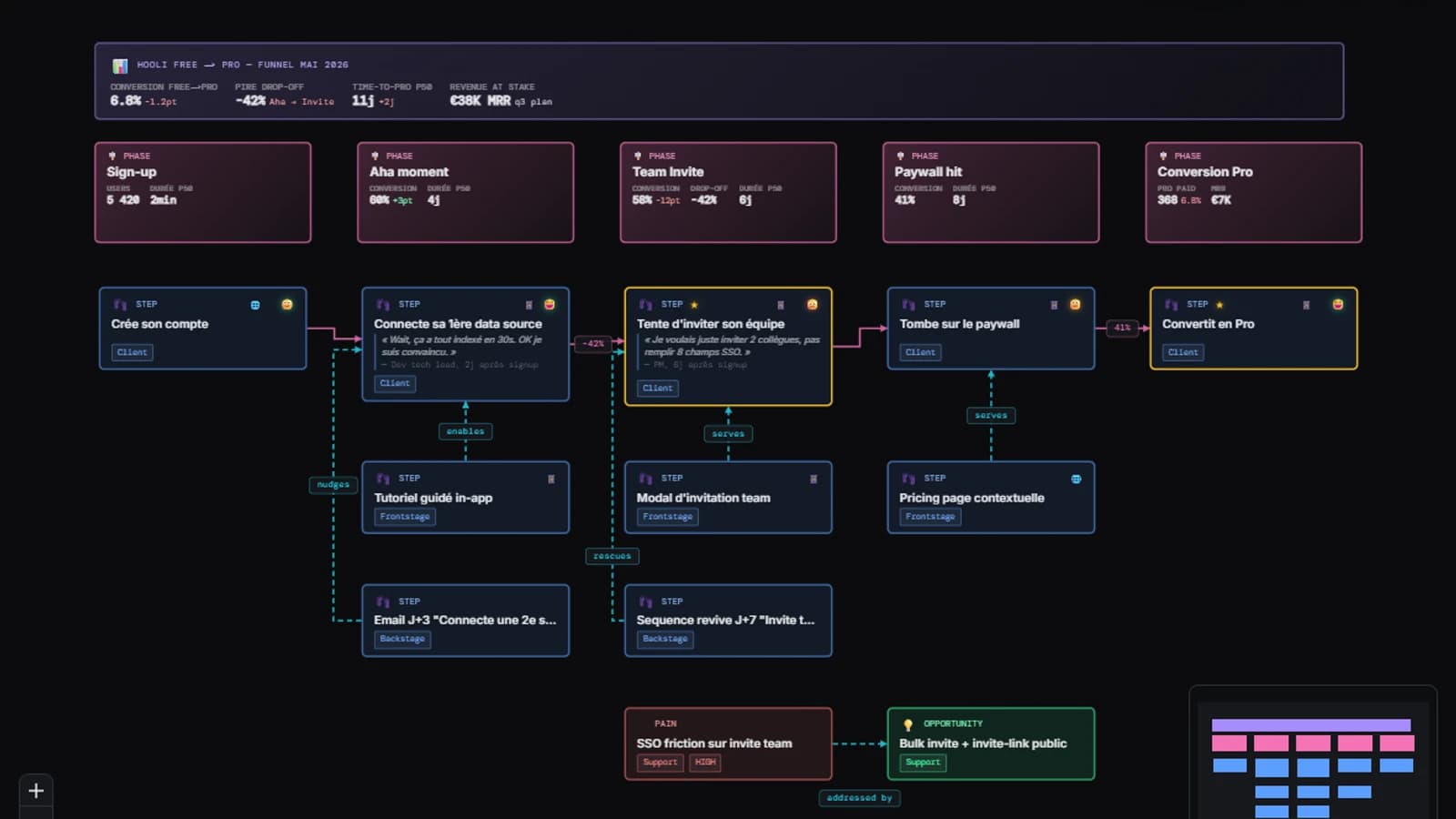
Conversational customer journey: touchpoints, frontstage/backstage, emotions. Structured, versioned, exportable.
Customer journey
- 01
Frontstage / backstage
Separates what the customer sees (app, email, call) from what happens behind the scenes (kitchen, logistics, tier-2 support) — a real service blueprint, not just a timeline.
- 02
Emotional states
Trace the journey's emotional curve — where the customer is frustrated, where they're won over. Friction points jump out at a glance.
- 03
Multi-channel touchpoints
App, email, phone, store, chat — every touchpoint is a structured block with its channel, not an anonymous whiteboard box.
- 04
Metrics per step
Conversion rate, NPS, average time — attach your metrics directly to the relevant step to keep the business context.
- 05
Described in natural language
"Create the signup journey for a SaaS user" is enough. The AI builds the structure, you adjust it by chatting or editing directly on the canvas.
- 06
Versioned
Unlike a whiteboard that drifts with every workshop, every evolution of the journey stays tracked and comparable in the version history.
Use cases: say it, get it
- Prompt
Create the signup journey for a SaaS user: landing → signup → onboarding → activation
- Prompt
Service blueprint for ordering a meal: front (app) and back (kitchen, courier)
- Prompt
Customer journey for a B2B prospect: awareness → consideration → decision → renewal
- Prompt
Map the emotions and friction points on the e-commerce purchase journey
What diagrams can you generate?
Ready to structure your customer journey?
Describe your journey in natural language — OrgGen produces an editable blueprint.